

How each euro spent on the National Lottery is split, how much reaches sport, the arts, youth and health, how sales have changed since 2018, and what the State regulator does.
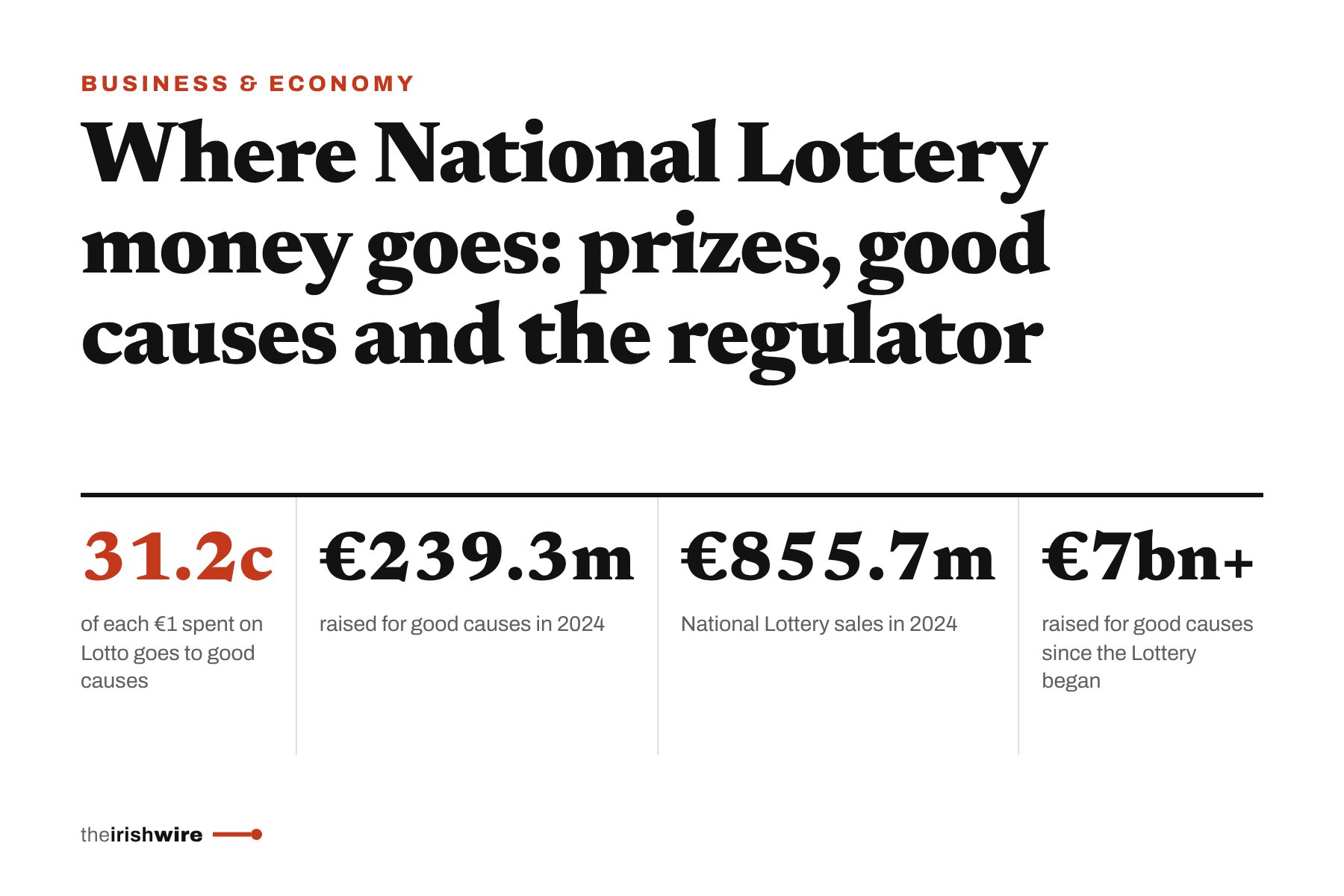
When you spend €1 on Lotto, about 31 cent goes to good causes such as sport, the arts and youth services. More than half goes back to players as prizes. The shop that sold the ticket keeps 6 cent.
How each euro is split
The Regulator of the National Lottery is the State body that oversees the game. It gives this worked example for €1 spent on Lotto each week.
| Who gets it | Amount | What it is for |
|---|---|---|
| Players | 52c | Prizes |
| Good causes | 31.2c | Sport, arts, youth, health, heritage and more |
| Operator | 10.8c | Running the game, and any profit |
| Retailer | 6c | Commission on the sale |
The operator holds a State licence to run the games and keeps any profit. The State sets the rules and checks the money.
The rules behind the split
Two rules decide the split. The National Lottery Act 2013 says at least half of all sales, on average, must go to prizes each year. The licence then says 65% of what is left after prizes must go to good causes.
So when more of the money goes on prizes, less is left for good causes. Retailers get 6% of sales, or 5% for one game, Lotto 5-4-3-2-1. The operator keeps whatever remains after prizes, good causes, retailers and the regulator's levy.
Sales peaked in 2021
Sales hit a high of over €1 billion in 2021. They fell back in 2022 and 2023, then rose again in 2024. Good causes money followed the same pattern.
In 2024, players won €487.6 million in prizes. That was 57% of sales. Draw games like Lotto made €540.1 million of sales, and scratch cards and other instant games €315.6 million.
Online play is growing. Online sales were €155.1 million in 2024, or 18.1% of all sales, up from 15.9% in 2023. In 2023, about 1.2 million people played each week on average.
Where the good causes money goes
The money goes into the National Lottery Fund each week. The Regulator moves it to the Exchequer, the State's central fund, every two months. The Government then decides how to share it out.
- Sport and recreation
- National culture and heritage, including the Irish language
- The arts
- Health of the community
- Youth, welfare and amenities
- The natural environment
These purposes are set out in Section 41 of the National Lottery Act. Lottery money does not fund whole programmes on its own. It is added to ordinary tax-funded spending on the same schemes.
| Programme | 2023 spending | Area |
|---|---|---|
| Arts Council grants | €130.5m | Arts |
| Sport Ireland grants to sports bodies and local sports partnerships | €104.8m | Sport |
| Youth Service Grant Scheme and UBU Your Place Your Space | Almost €76m | Youth |
| Heritage Council grant | €14.2m | Heritage |
| Mobility Aid Grants | €4.9m | Housing |
| HSE National Lottery Grant Scheme | €4.5m | Health |
estimated share of the €405.4 million spent on these programmes in 2023 that came from the Lottery
Source: assets.gov.ieThe Irish language is supported through the Language Support Schemes. Community groups get help through the Scheme to Support National Organisations and the Seniors Alert Scheme. On average, over 4,500 groups benefit each year.
“An incredible €6 billion has been raised for Good Causes since the National Lottery was established.”— Paschal Donohoe, Minister for Public Expenditure, 27 December 2024
The Regulator now puts the total at over €7 billion since the Lottery began in 1987.
What the regulator does
The Office of the Regulator of the National Lottery is a small State body with about 10 staff. Its job is to oversee the Lottery and make sure the operator follows the law and its licence.
- Runs the competition to choose who holds the licence
- Checks the split between prizes and good causes each week, game by game
- Approves new games and changes to rules
- Manages the National Lottery Fund
- Handles complaints the operator has not resolved: 35 in 2024
- Takes action for breaches, such as withholding €23,000 from the operator in 2024
The operator pays for the Regulator through a yearly levy. It started at €1.5 million and rises with inflation. For 2026, it is €1,857,300.
The Regulator has no role in deciding who gets good causes funding. That is a matter for Government departments and the bodies they fund.
Protecting players
You must be 18 to play. In 2024, test buyers under 18 tried to buy tickets in 562 shops. Seven in 10 of those test purchases were refused.
Of the shops tested, 92% displayed the 18+ sign. Since 2023, everyone with an online account must have their ID checked.
What this means for you
- About 31 cent of each euro on Lotto goes to good causes. The figure varies a little by game.
- If your club or group wants funding, apply to the right body, such as Sport Ireland or the Arts Council, not the Regulator.
- Sports clubs can apply through the Sports Capital Programme. Health groups apply through the HSE National Lottery Grant scheme.
- Lottery games are for over-18s only, in shops and online.
- Online accounts need ID checks, and spending limits apply.
Most of the money spent on the Lottery goes to good causes.
Prizes take the biggest share. In 2024, 57% of sales went on prizes and 28% to good causes.
Regulator's Annual Report for 2025, with sales and good causes figures
Department of Public Expenditure's next National Lottery Good Causes report
Regulator's levy on the operator rises again with inflation
- Regulator of the National Lottery: Annual Report 2024
- Regulator of the National Lottery: Calculation of Good Causes Funds
- Regulator of the National Lottery: Allocation of proceeds
- Regulator of the National Lottery: Good Causes Funds
- Regulator of the National Lottery: Distribution of Good Causes Funds
- Regulator of the National Lottery: Prize allocation
- Department of Public Expenditure: National Lottery Good Causes Funding 2023
- Department of Public Expenditure: Minister publishes National Lottery Good Causes Report 2023, 27 December 2024
