


Which public hospital charges still apply, who is exempt, why staying overnight as a public patient is now free, and what private patients pay in a public hospital.
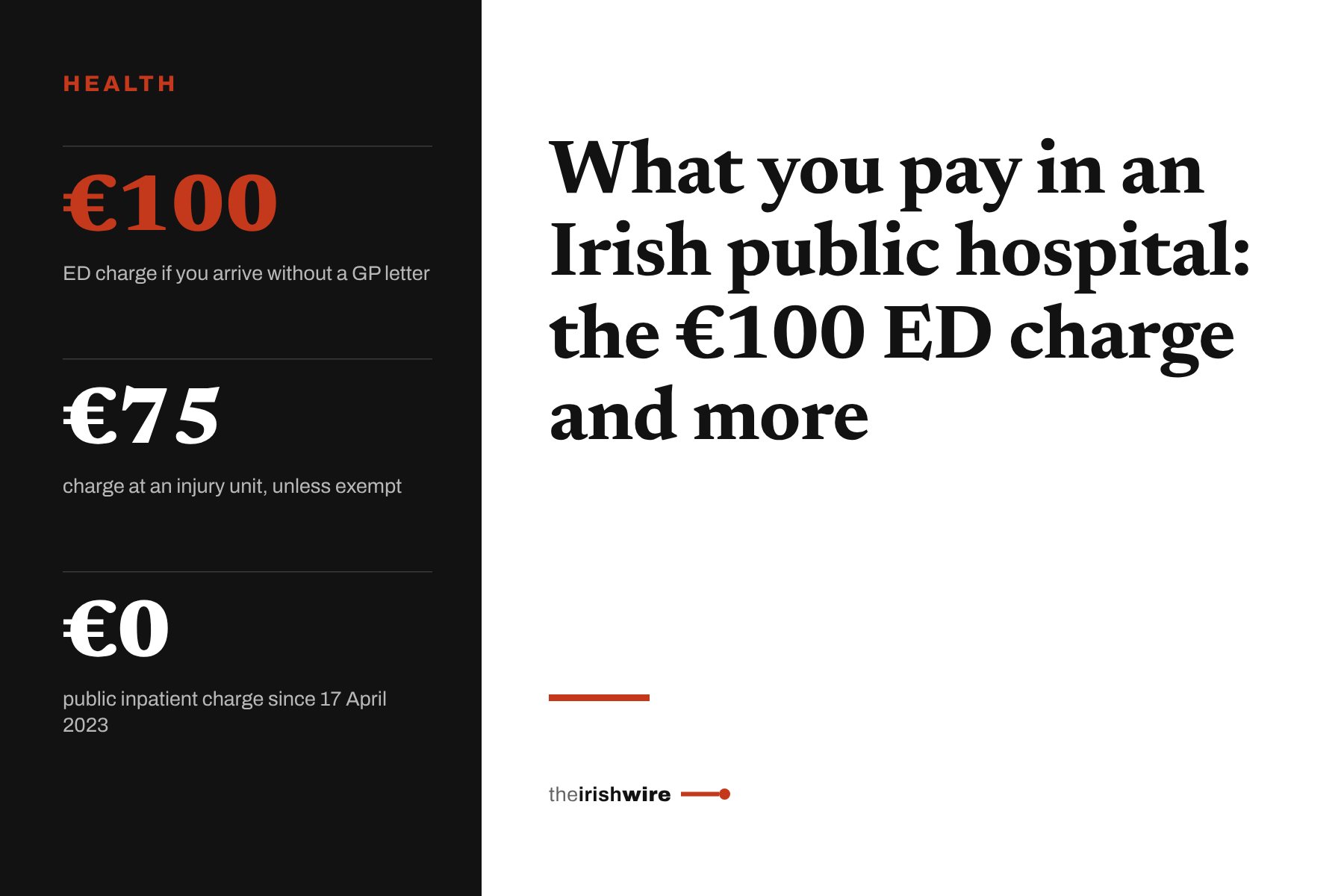
A bed in a public hospital is free for public patients. The €80-a-day inpatient charge was abolished on 17 April 2023. The charge most people still meet is at the door: €100 if you walk into an emergency department without a GP letter.
The charges at a glance
| Service | Charge | Notes |
|---|---|---|
| Emergency department, no GP letter | €100 | Once per illness or accident |
| Emergency department, with GP letter | €0 | Bring the letter with you |
| Injury unit | €75 | €0 with a medical card or GP letter |
| Public inpatient or day case | €0 | Since 17 April 2023 |
| Public outpatient, GP-referred | €0 | No charge for public patients |
| Private patient, single room | €800 to €1,000 a night | Plus consultant fees |
| Private patient, shared room | €659 to €813 a night | Plus consultant fees |
| Private patient, day case | €329 to €407 | Plus consultant fees |
The €100 emergency department charge
If you go to an emergency department (ED) without a referral letter from a GP, you are charged €100. With a GP letter, there is no charge, so bring it with you.
You pay once for each illness or accident. If you go back to an outpatient clinic for the same problem, you are not charged again.
Who does not pay the ED charge
- Medical card holders
- Women getting maternity care
- Babies up to 6 weeks old, and children referred from child health clinics or school checks
- People treated for certain infectious diseases, including COVID-19
- People admitted to a ward after the ED
- People with a Health Amendment Act card for Hepatitis C
Children with certain conditions are also exempt. These include cystic fibrosis, spina bifida, haemophilia and cerebral palsy. People covered under EU rules and people in the Redress Scheme for women in certain institutions are exempt too.
A GP visit card is not a medical card. Citizens Information says it does not cover hospital charges.
Injury units cost less
An injury unit treats injuries that are not life-threatening, like broken bones, sprains, cuts, minor burns and minor head injuries where the person stayed conscious. A visit costs €75.
There is no charge with a medical card or a referral letter. If the injury unit sends you on to an ED, you do not pay a second fee. Most units treat patients aged over 5, so check the age policy before you bring a young child.
Staying in hospital as a public patient is free
Until April 2023, public patients paid €80 a day for a hospital stay, up to €800 in any 12 months. That charge, and the charge for day services, ended on 17 April 2023. Children under 16 stopped paying it on 21 September 2022.
the most an adult public patient could pay in inpatient charges in 12 months before the charge was abolished
Source: gov.ie“from today, people will no longer be charged when accessing public inpatient care in our public hospitals.”— Stephen Donnelly, then Minister for Health, 17 April 2023
Outpatient appointments
An outpatient appointment is when you see a hospital consultant without staying in. Public patients referred by a GP pay nothing. If you choose to see a consultant privately, you pay their fee.
Outpatient mental health services are free for children under 16.
Private patients in a public hospital
Public patients do not pay consultants' fees, but they do not choose their consultant. A private patient in a public hospital becomes the private patient of the treating consultant and pays for all their treatment.
On top of consultant fees, private patients pay a daily hospital charge. It depends on the room and the hospital category. Health insurance may cover some or all of it.
Private patients also pay any other consultants involved in their care, such as an anaesthetist. Check what your insurance covers before you agree to be treated privately.
Long stays and people living abroad
Two other charges can apply in public hospitals:
- Long-stay contribution: if you stay over 30 days without needing acute care
- Full cost of bed and consultant: if you are not ordinarily resident in Ireland and not exempt
The HSE can reduce or waive charges for people who are not resident in cases of hardship.
Medicines after you go home
Prescriptions you take home are not hospital charges. They are covered by the medical card or the Drugs Payment Scheme. See our guide to the Drugs Payment Scheme card.
What this means for you
- Not an emergency? Call your GP or GP out-of-hours service first. A GP letter means no ED charge.
- For a sprain, cut or broken bone, an injury unit costs €75, not €100.
- Medical card holders pay no ED or injury unit charge.
- As a public inpatient, you will not get a bill for your bed.
- Asked to go private? Check your insurance cover and consultant fees first.
Public patients still pay €80 a night to stay in hospital.
Public inpatient and day service charges were abolished on 17 April 2023. A public patient pays nothing for their hospital bed.
Budget 2027 did not announce any change to hospital charges. If someone's life is at risk, call 112 or 999 for an ambulance.
Expanded surgical hubs with six-day operations, funded in Budget 2027
Equal access to GP out-of-hours services across the six health regions, a Budget 2027 aim
Emergency department attendance figures as winter pressure peaks
- Citizens Information: Charges for hospital services, updated 1 August 2026
- Citizens Information: Hospital services in Ireland
- Citizens Information: GP visit cards
- HSE: When to visit an injury unit
- HSE: The emergency department
- HSE: What a medical card covers
- HSE: Drugs Payment Scheme
- Department of Health: Abolition of public hospital in-patient charges, 17 April 2023
- Department of Health: Annual Report 2025
- Department of Health: Budget 2027 delivers €29.1 billion for health services
