


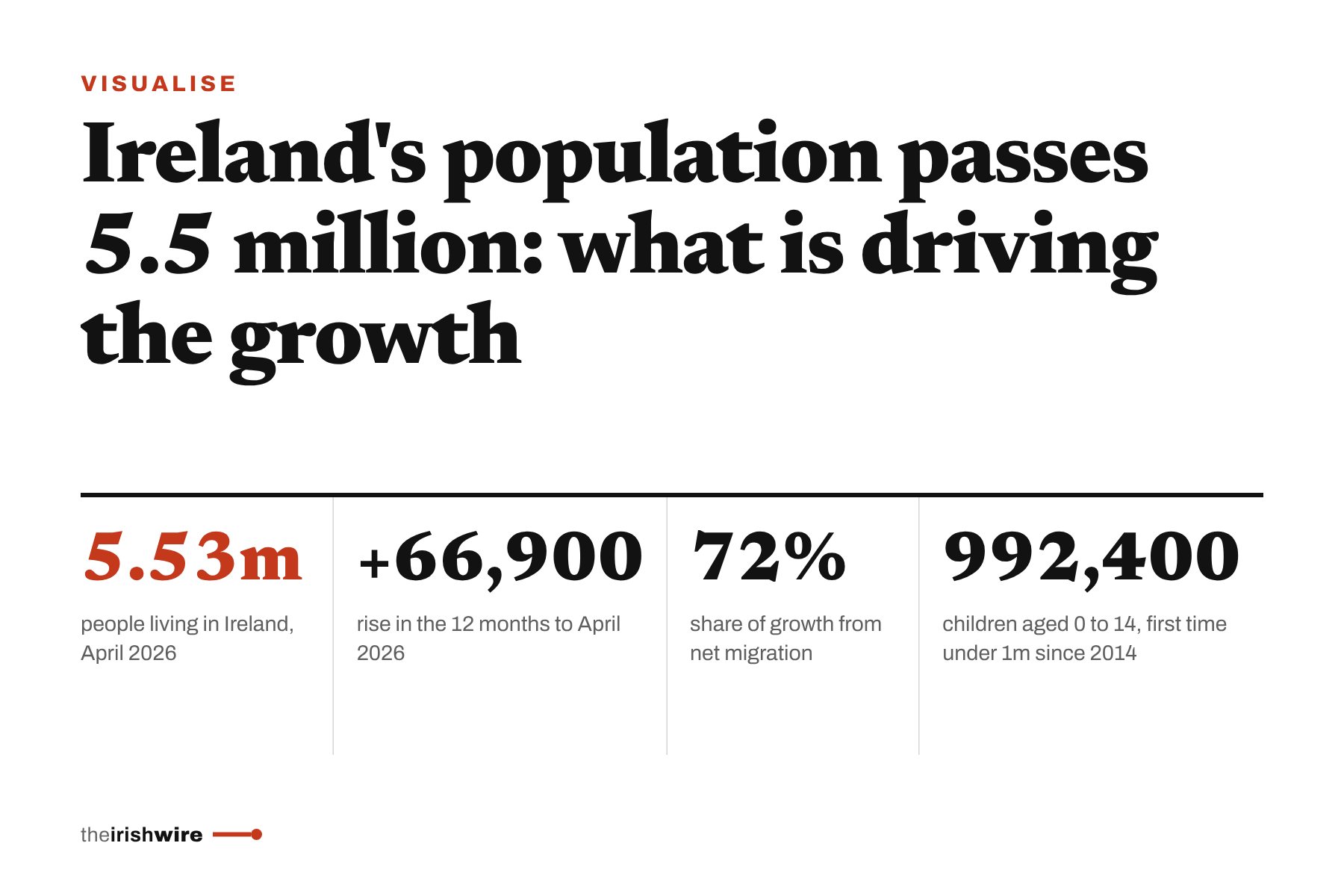
The CSO's April 2026 estimates show a bigger but slower-growing population. Here is how births, deaths, arrivals and departures add up, and how the age mix and regions are changing.
Ireland now has 5,525,600 people, according to the Central Statistics Office (CSO). That is 66,900 more than a year earlier, or about 183 extra people a day. But the growth is slowing: it is the smallest yearly rise since 2021.
Growth is slowing for a second year
The population grew by 98,700 in the year to April 2024. It then grew by 78,300, and now by 66,900. It is still growing, just more slowly.
These are estimates, not a head count. The CSO starts from the last census and adds births and arrivals, then takes away deaths and departures. It revises the figures when new census results come in.
Two things change a population
The first is natural increase: births minus deaths. The second is net migration: people who moved here minus people who left. To count as a migrant, a person must move for at least 12 months.
| 2025 | 2026 | |
|---|---|---|
| Births | 54,400 | 54,300 |
| Deaths | 35,800 | 35,400 |
| Natural increase | 18,600 | 18,800 |
| Immigrants (arrivals) | 125,300 | 110,600 |
| Emigrants (departures) | 65,600 | 62,500 |
| Net migration | 59,700 | 48,100 |
| Total change | 78,300 | 66,900 |
Births and deaths barely moved. Almost all of the slowdown came from fewer arrivals.
Fewer births than ten years ago
There were 54,300 births in the latest year. Ten years earlier, in the year to April 2016, there were 65,400. Deaths rose over the same time, from 29,800 to 35,400.
So the gap between births and deaths has nearly halved. It fell from 35,600 to 18,800.
The youngest group shows the same pattern. There are about 55,000 babies under one year old. That is 27% fewer than in 2010.
Ireland's population is growing mainly because of a high birth rate.
Births added 18,800 more people than deaths in the year to April 2026. Net migration added 48,100, about 72% of the growth.
Who is arriving
About 110,600 people moved to Ireland in the year to April 2026. That is 12% fewer than a year earlier, but still the fifth year in a row above 100,000. Arrivals peaked at 149,200 in the year to April 2024, the highest in the past ten years.
Arrivals fell in every group. Returning Irish citizens fell least, down 4% to 30,200. Arrivals from other EU countries fell 18%.
Who is leaving
Emigration fell for the second year in a row, to 62,500. More than half of those leaving were Irish citizens: 35,400 people.
Because 35,400 Irish citizens left and 30,200 came back, Ireland had a net outflow of 5,200 of its own citizens. Every other citizenship group had more arrivals than departures. For people from outside the EU and UK, 55,500 arrived and 16,400 left.
people moved to Australia in the year, down 13%, while 8,300 came the other way, down 18%
Source: cso.iePeople aged 25 to 44 made up 53% of both arrivals and departures. For where migrants settle, see our migration map.
Fewer children, more older people
There are 992,400 children aged 0 to 14. That is 7,700 fewer than last year, and the first time below 1 million since 2014.
Older people are a growing share of the country. People aged 65 and over were 14.4% of the population in 2020. Now they are 16.1%.
The working-age middle is shifting
About 1,443,000 people are aged 45 to 64. People aged 25 to 44 make up 27.0% of the population, but this group shrank by 4,400 in the year.
Young adults aged 15 to 24 are 12.8% of the population. This is the age group most likely to emigrate.
Dublin grows fastest, one region shrinks
| Region | People | Share |
|---|---|---|
| Dublin | 1,597,700 | 28.9% |
| South-West | 792,900 | 14.3% |
| Mid-East | 788,400 | 14.3% |
| Mid-West | 543,000 | 9.8% |
| West | 531,100 | 9.6% |
| South-East | 485,400 | 8.8% |
| Border | 447,600 | 8.1% |
| Midland | 339,400 | 6.1% |
Dublin added 29,700 people, the biggest rise of any region. The West had the next biggest rise, 11,500 people, or 2.2%. The South-East was the only region to shrink, by 1,000 people.
more than four in ten of the State's extra people in the year were in Dublin: 29,700 out of 66,900
Source: cso.ieEach region is a group of counties used for EU statistics. The Midland region is the smallest, with 6.1% of the population. The South-West and Mid-East each hold about one in seven people.
How the CSO makes these estimates
- It starts from the last census, Census 2022, and moves everyone on a year.
- It adds births and takes away deaths, from official registrations.
- It estimates arrivals and departures mainly from the Labour Force Survey, a large household survey.
- It cross-checks with PPS numbers, residence permits and visa data.
- The count date is the end of April each year.
Births and deaths cover the 12 months to the end of March, so they line up closely with the migration year.
What this means for you
- Births are steady at about 54,000 a year, so arrivals now decide how fast Ireland grows.
- The over-65s grew by 30,000 in a year, while the number of children fell.
- More Irish citizens left than came home, but the gap was small: 5,200 people.
- These are estimates. The CSO revises them when census results come in.
- You can explore the figures yourself in CSO table PEA15 on data.cso.ie.
CSO Population and Migration Estimates for April 2027 (this year's came out on 24 August 2026)
Census 2027, which the CSO will use to check and revise these estimates
CSO Labour Force Survey, the main source for the migration estimates
