


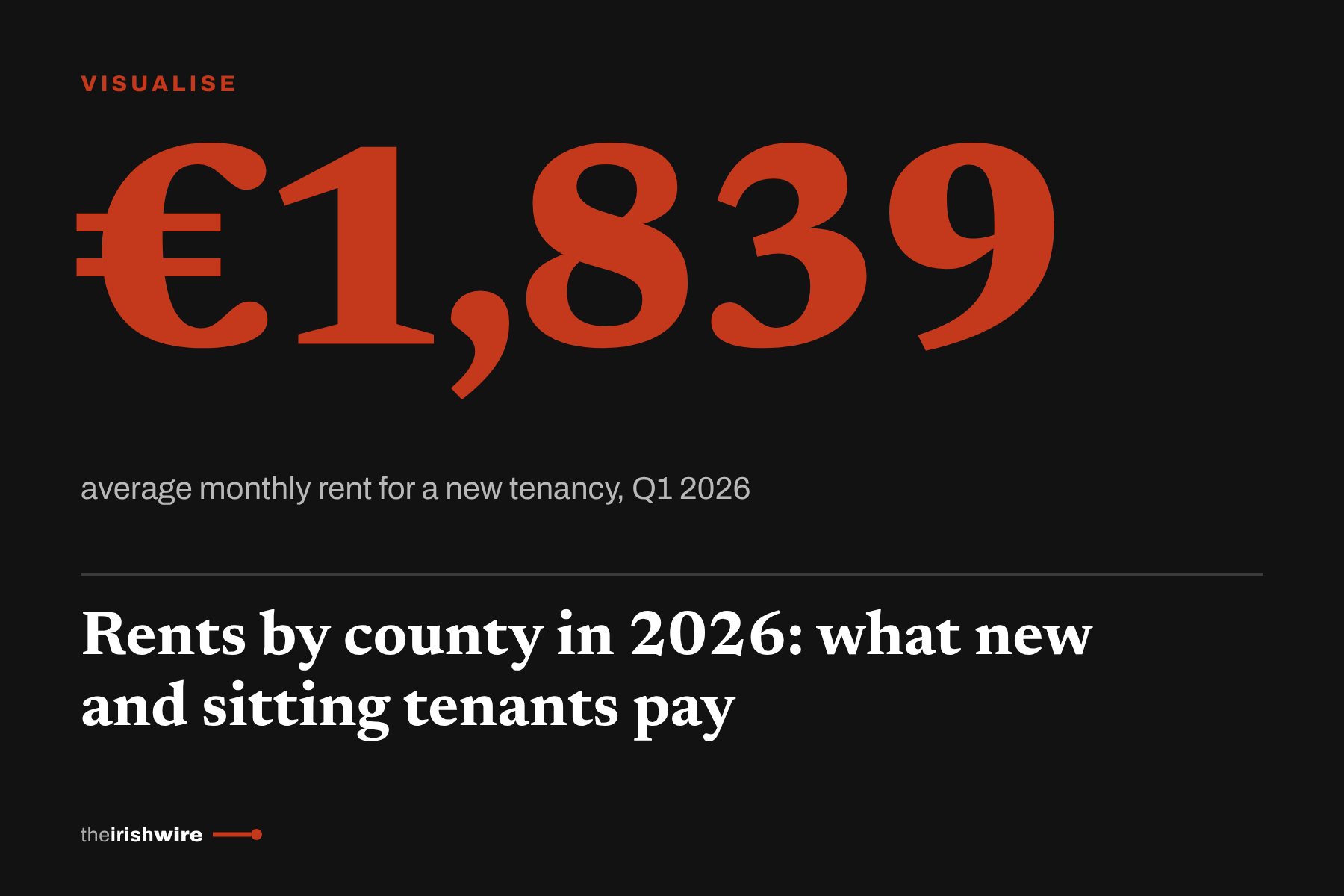
The latest RTB Rent Index shows average monthly rents in every county, how fast they rose in a year, and the gap between new tenancies and people already renting.
A new tenancy in Ireland cost an average of €1,839 a month in the first three months of 2026. That is 9.1% more than a year earlier. People already in their homes paid much less: €1,513 a month on average.
What the Rent Index measures
The figures come from the RTB/ESRI Rent Index. The RTB (Residential Tenancies Board) registers private tenancies, and the ESRI (Economic and Social Research Institute) helps build the index. The latest edition covers January to March 2026, known as Q1 2026.
It uses a "standardised" average rent. That means the figures are adjusted so that a change in the mix of homes, such as more apartments one quarter, does not distort the trend.
- New tenancies: lettings that began in the quarter, 13,019 of them in Q1 2026
- Existing tenancies: people already renting, from 46,510 yearly registrations
- Both are monthly rents, in euro, for the whole home
Rent in every county
After Dublin, the dearest counties for new tenancies were Wicklow at €1,888 and Kildare at €1,852. Limerick (€1,744), Galway (€1,718) and Meath (€1,706) came next.
The cheapest were Leitrim at €1,040, Monaghan at €1,081 and Donegal at €1,107. A new tenancy in Dublin cost more than twice as much as one in Leitrim.
In 18 of the 26 counties, a new tenancy averaged under €1,500 a month. Only six averaged €1,700 or more. Cork was just below that, at €1,678, after a rise of 12.9% in a year.
| County | New tenancy | Existing tenancy | Change in a year (new) |
|---|---|---|---|
| Dublin | €2,335 | €1,960 | +7.8% |
| Wicklow | €1,888 | €1,437 | +10.5% |
| Kildare | €1,852 | €1,489 | +10.1% |
| Limerick | €1,744 | €1,186 | +16.3% |
| Galway | €1,718 | €1,303 | +10.7% |
| Mayo | €1,153 | €978 | +5.7% |
| Roscommon | €1,132 | €1,002 | +4.4% |
| Donegal | €1,107 | €872 | +3.9% |
| Monaghan | €1,081 | €914 | +4.6% |
| Leitrim | €1,040 | €881 | -3.1% |
Local areas show even bigger gaps
The index also gives rents for local electoral areas, the areas used for council elections. Stillorgan in Dublin was the dearest, at €2,975 a month for a new tenancy.
For existing tenancies, Stillorgan was again highest at €2,590. Belmullet in Mayo was lowest at €685. At county level, Dublin's existing tenancies averaged €1,960 and Donegal's €872, the lowest.
Where rents rose fastest
Across the whole country, new tenancy rents rose 4.3% in just one quarter, from the end of 2025 to the start of 2026. Sitting tenants saw a rise of 0.7% over the same three months.
rise in new tenancy rents in Clare over the year to Q1 2026, the fastest of any county
Source: rtb.ieNew tenancy rents rose in 25 of the 26 counties over the year. Clare had the biggest rise, at 19.1%. Limerick (16.3%), Westmeath (13.7%), Cork (12.9%) and Carlow (11.1%) followed.
In Dublin, new rents rose 7.8%. In the rest of the Greater Dublin Area, which the RTB reports separately, they rose 9.4% to €1,806. Outside that area, they rose 8.9% to €1,432.
Rents are rising at about the same pace everywhere.
In the year to Q1 2026, new tenancy rents rose 19.1% in Clare but fell 3.1% in Leitrim. Smaller counties have fewer new lettings, so their figures can swing more.
New tenants pay more than sitting tenants
People who stay in the same home pay less, because rent increases for sitting tenants are limited by law. The gap was €326 a month in Q1 2026.
Over a full year, that gap adds up to about €3,900. In Dublin, new tenants paid €375 a month more than sitting tenants, or €4,500 a year. So moving home can mean a big jump in rent, even within the same area.
Existing tenancy rents rose 4.2% in a year. The biggest rises for sitting tenants were in Leitrim (8.7%) and Donegal (8.3%), although both still have some of the lowest rents.
New rent rules from 1 March 2026
The RTB links part of the jump in new tenancy rents to rule changes from 1 March 2026. These let rents be reset to market level between tenancies. It says it is too early to tell how much is a one-off.
For sitting tenants, yearly increases are now capped at 2% or the rate of inflation, whichever is lower. For the full rules, see our guide to landlord and tenant law in Ireland.
What CSO price data says
The CSO's Consumer Price Index tracks rents every month, across all tenancies rather than only new ones. In the year to September 2026, private rents rose 4.7%. Local authority rents rose 12.7%.
The CSO's last Household Budget Survey, for 2022-2023, found renting households spent €174.06 a week on housing. That was 24.2% of everything they spent, a higher share than for homeowners.
What this means for you
- If you are moving, expect to pay close to the new tenancy average for your county, not the existing one.
- Since 1 March 2026, landlords must give you and the RTB a rent setting notice explaining how the rent was set.
- From 14 September 2026, the RTB can issue a €200 fixed payment notice for each breach of rent setting rules.
- Budget 2027 raises the Rent Tax Credit to €1,150 for a single person. See our Rent Tax Credit guide.
RTB/ESRI Rent Index for Q2 2026 (date not yet announced)
CSO Consumer Price Index tracks private and local authority rents
