


How much the Croí Cónaithe grant pays, who qualifies, the rules on living in or renting the home, how to apply through your council, and how many grants have been paid.
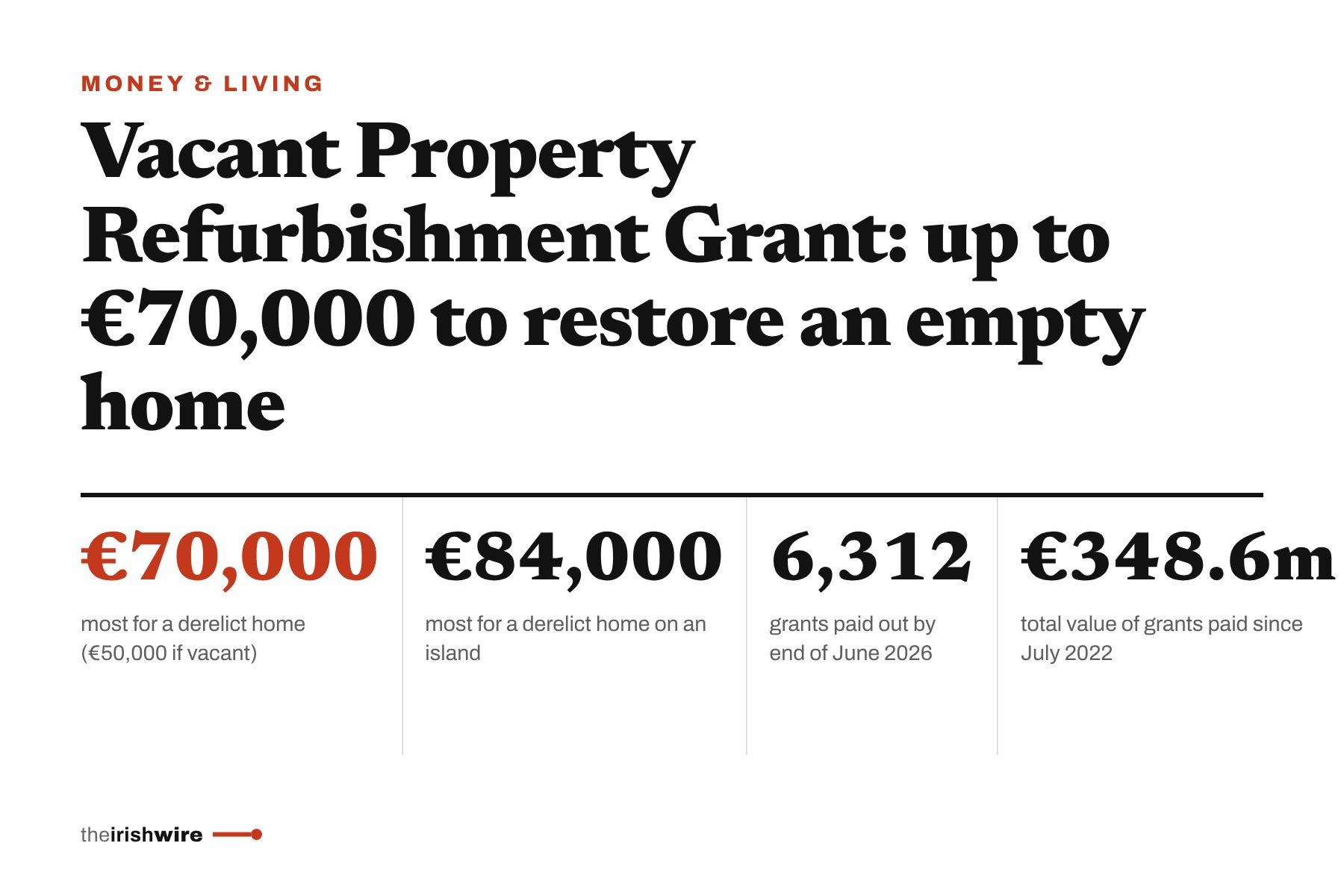
More than 6,300 empty or derelict homes have been brought back into use with this grant since July 2022. The State has paid €348.6 million to do it. Between April and June 2026 alone, 923 homes were finished.
What the grant pays
The Vacant Property Refurbishment Grant is part of the Croí Cónaithe Towns Fund. It is paid by your local council to help you repair a home that has been empty for at least two years.
Despite the name, it is not only for towns. It covers cities, towns, villages and rural areas.
| Type of property | Maximum grant | On an island |
|---|---|---|
| Vacant home | €50,000 | €60,000 |
| Derelict home (with top-up) | €70,000 | €84,000 |
| Former shop or public building, 2 homes (vacant / derelict) | €70,000 / €90,000 | Not stated |
| Former shop or public building, 3+ homes (vacant / derelict) | €90,000 / €110,000 | Not stated |
| Expert advice before a conversion | €5,000 | Not stated |
The grant includes VAT. It can never be more than the approved cost of the work, and each type of work has its own limit.
If the home is not on the register, you need a report from an independent professional to show it is derelict. Island properties get rates up to 20% higher.
Who qualifies
- The home has been empty for two years or more when you apply
- It was built before 2008
- You own it, or you are actively buying it
- You apply as a named person: registered companies and developers cannot apply
- Your Local Property Tax is in order and you have tax clearance
- Farm buildings, and homes knocked down and rebuilt as new builds, are not eligible
You must prove the home was empty, for example with utility bills. Keeping a home empty on purpose to qualify is not allowed.
One person can get up to two grants: one for a home to live in and one for a home to rent out.
Live in it or rent it out
You must either live in the home as your main home, or rent it out. If you rent it, the tenancy must be registered with the RTB (Residential Tenancies Board), and you must send proof every year for ten years.
You can only get the grant if you move into the house yourself.
You can also rent the home out, as long as it is a long-term tenancy registered with the RTB. Short-term or holiday lets, such as Airbnb, are not allowed.
The conditions last ten years from the date the grant is paid. If you sell the home, stop living in it or stop renting it in that time, you may have to pay back some or all of the grant.
How to apply through your council
- Check the home has been empty for two years, was built before 2008 and that you own it or are buying it.
- Pick the right form: the single home form, or the conversion form if a whole building will become two or more homes.
- Gather proof of vacancy, proof of ownership, a quote for the work and, if derelict, a professional's report.
- Send the form to the council where the property is. A council technical officer will inspect the property and check the costs.
- Once approved, do the work, then send invoices and tax clearance. The council inspects the finished work and pays the grant.
Forms and the scheme outline are on the gov.ie grant page. Each council has a Vacant Homes Officer who can answer questions.
If you are refused, you can appeal in writing within three weeks. A different official reviews it, and a decision can take up to six weeks.
How many grants have been paid
Payments are made only once the work is done. In 2025, 3,066 grants were paid, up 127% on 1,349 in 2024.
applications approved since July 2022, so many more homes are still being worked on
Source: gov.ieDonegal has used the grant most. By mid-2026, its council had 1,638 applications, 1,233 approvals and 542 homes paid for, worth €30.9 million.
“Six previously vacant properties are being brought back into active use every working day across Ireland.”— James Browne, Minister for Housing, 17 July 2026
What changed in 2026
The Government has extended the grant to 2030. Since 31 March 2026, bigger grants are available to turn a whole former shop, office or public building into two or more homes.
A separate Vacant Above the Shop grant, worth up to €140,000, became available from the end of March 2026. The Budget 2027 housing package, published on 6 October 2026, did not announce new grant amounts.
The tax on empty homes
The Vacant Homes Tax is a yearly tax on homes that are used for less than 30 days in a year. It is collected by Revenue and is paid on top of Local Property Tax.
As of July 2025, about 2,300 properties were liable, raising €2.2 million. Some exemptions apply, so check Revenue's guide.
What this means for you
- If you own a home that has been empty for two years, you could get up to €50,000, or €70,000 if it is derelict.
- Contact your council's Vacant Homes Officer with questions before you apply.
- You can combine the grant with a separate SEAI energy grant, but not for the same work.
- If you plan to rent it out, budget for ten years of RTB registration and long-term letting.
- An empty home can cost you Vacant Homes Tax at seven times your property tax each year.
Department of Housing publishes updated grant statistics by council
Grant extended until 2030
- Department of Housing: Vacant Property Refurbishment Grant scheme outline, August 2026
- gov.ie: How to apply, Vacant Property Refurbishment Grant 2026
- Department of Housing: Vacant Property Refurbishment Grant FAQs, August 2026
- Department of Housing: more than 6,300 homes restored (17 July 2026)
- Department of Housing: over 3,000 homes back in use in 2025 (26 January 2026)
- Department of Housing: €112 million paid (28 April 2025)
- Department of Housing: €155 million paid (18 July 2025)
- Department of Housing: over €200 million paid (Q3 2025 figures)
- Department of Housing: Vacant Homes Tax
- Revenue: Vacant Homes Tax
- Department of Housing: Budget 2027 package
