


You can rent a room in your home and pay no tax on the income, up to a limit that rises in January. Here is who qualifies, what counts, how it affects welfare and medical cards, and how to claim.
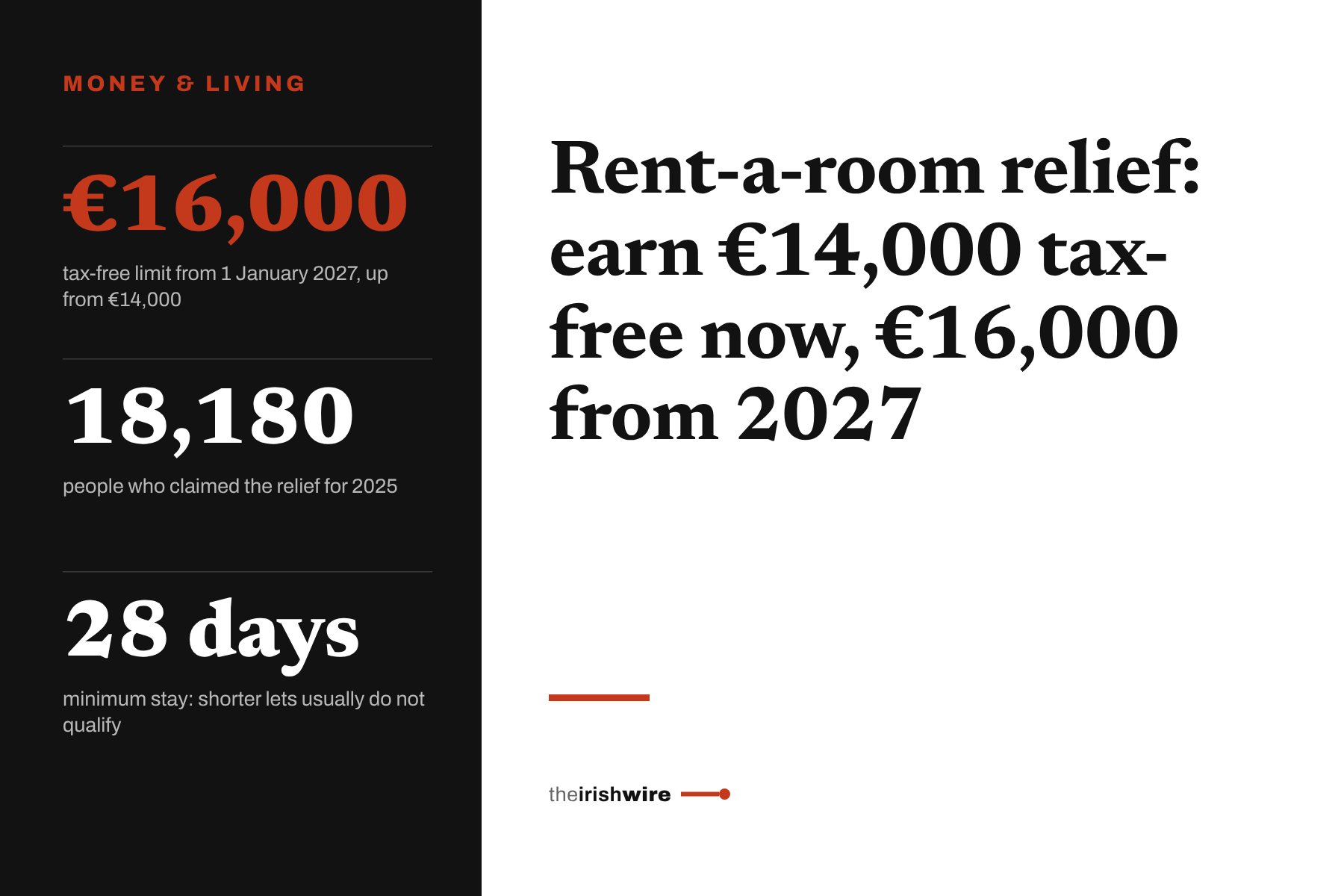
Go even €1 over the limit and you lose the relief on all of it. If your room income for the year is above €14,000, Revenue taxes the whole amount, less expenses, not only the part over the limit. From 1 January 2027, the limit rises to €16,000.
What rent-a-room relief is
Rent-a-room relief lets you earn money from renting a room in your home without paying income tax, PRSI or USC on it. You still have to declare the income on your tax return.
The Department of Finance estimates the change will cost €24 million in a full year. A single €16,000 limit will cover all your rent-a-room income.
Who can claim
- The home must be in the State and be your main home, where you live for most of the year
- You do not have to own it: a tenant can sublet a room, but should ask the landlord first
- Local authority tenants can rent a room to a third-level student, but must ask the council first
- A self-contained unit attached to your home, such as a basement flat or converted garage, can qualify
- Only individuals can claim, not companies
If two people own the home and share the rent, they split the limit between them. A couple who are jointly assessed also share one limit.
Garden homes now count too
Budget 2027 extended the relief to some detached homes built in back gardens. These are called designated auxiliary dwellings. They must be installed after 27 July 2026, measure 32 to 45 square metres and meet new planning exemption rules.
The change applies back to 27 July 2026. Other detached units that are not attached to your home, such as one built before that date, still do not qualify.
What counts towards the limit
The limit covers all the money you get from the person renting. That includes rent and anything extra you charge for meals, laundry, heat or electricity.
| Amount | Result | |
|---|---|---|
| Rent for the year | €13,000 | Under €14,000 |
| Meals provided | €1,500 | |
| Total received | €14,500 | Over the limit: all taxable |
| Same total in 2027 | €14,500 | Under €16,000: tax-free |
You cannot claim expenses against the income while you use the relief. If your costs are high, you can opt out for a year. You then pay tax on the profit, but can deduct expenses and wear and tear.
Students, digs and short stays
Since 1 January 2019, lets of 28 days in a row or less do not qualify. That rules out short-term guests, including those who book through online booking sites. For the rules on short-term letting, see our guide to the short-term letting changes.
- Full-time or part-time students, including language students
- Students in four-day-a-week "digs", Monday to Thursday
- Rooms let for an academic year or a term
- Respite care for a person with a disability
These shorter stays can still qualify, because they are not for leisure or business. If you also do short summer lets, that income is taxed separately.
Renting a room through a holiday booking site counts for rent-a-room relief.
Revenue says income from short-term guests staying 28 days or less, including online bookings, does not qualify. It is taxed as normal income.
You cannot claim the relief for renting to your own child, or your spouse's or civil partner's child. Income from your employer does not qualify either. Other relatives, such as a niece or nephew, can be tenants.
Welfare, medical cards and other taxes
Room income up to €14,000 a year is not counted in the means test for a medical card or GP visit card. For means-tested social welfare, up to €269.23 a week is ignored.
weekly room income ignored for means-tested payments, Working Family Payment, Fuel Allowance and the Household Benefits Package
Source: citizensinformation.ieThis welfare rule does not apply if you rent to a short-term guest or a close family member. Revenue says the relief has no effect on Mortgage Interest Relief, and you keep the Capital Gains Tax exemption when you sell your home.
More people are claiming it
Revenue figures show the number of people claiming the relief nearly doubled from 2021 to 2025. The cost to the State rose from €20.7 million to €47.3 million.
How to claim
- Keep a record of all the money you receive from your tenant, including for meals and bills.
- After the year ends, file your tax return. PAYE workers use Form 12 in myAccount.
- If you are self-employed, or have other income, use Form 11 in ROS.
- Enter the rent-a-room income in the exempt income section. The relief is given when the return is made.
- You can claim for up to four years back. Claims for 2022 must be made by 31 December 2026.
What this means for you
- Add up rent and extras before you set a price. Stay under the limit: €14,000 in 2026, €16,000 from 2027.
- Lets of 28 days or less, such as holiday bookings, do not qualify, but student digs do.
- Tell your landlord, or your council if you are a local authority tenant, before you rent a room.
- Declare the income on your tax return, even though it is tax-free.
- On welfare or a medical card? Up to €14,000 a year of room income is ignored.
The Finance Bill is expected to put the €16,000 limit and the garden homes extension into law
Rent-a-room limit rises from €14,000 to €16,000
Whether the €14,000 welfare and medical card disregards are raised to match the new tax limit
- Department of Finance: Budget 2027 Tax Policy Changes
- Citizens Information: Renting a room in your home
- Citizens Information: Budget 2027
- Revenue: Rent-a-Room Relief
- Revenue: Rent-a-Room Relief qualifying conditions
- Revenue: How rent-a-room relief affects other reliefs and taxes
- Revenue: Costs of tax expenditures
- Revenue: Costs of tax expenditures notes
- Government of Ireland: Your guide to Budget 2027
