


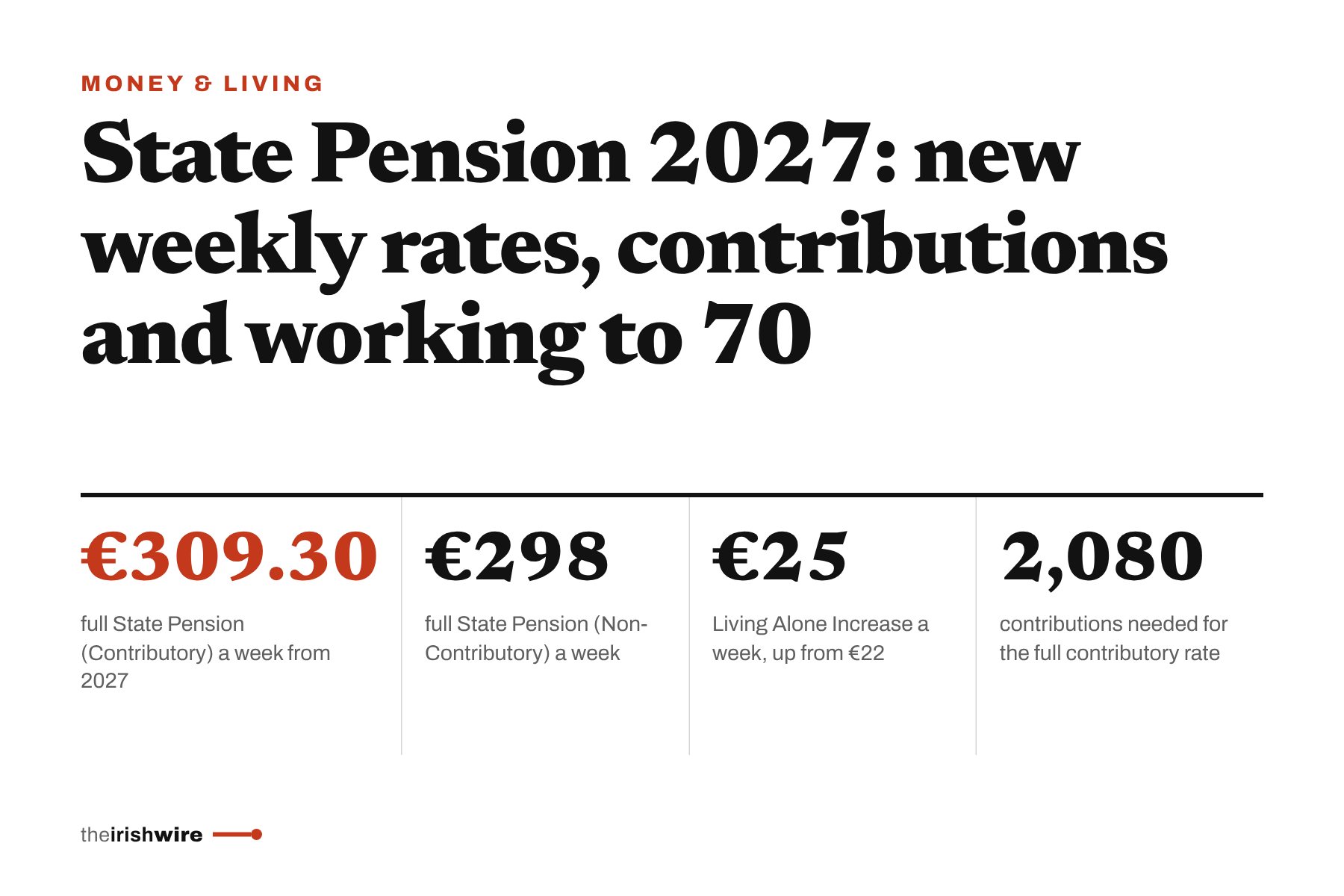
The full State Pension (Contributory) passes €300 a week for the first time in January 2027. Here are the new rates, the difference between the two main pensions, how many contributions you need and what you gain by waiting.
The full State Pension (Contributory) will be €309.30 a week from January 2027. That is the first time it has gone above €300. Over a year, it adds up to about €16,084.
Two pensions, two ways to qualify
There are two main State Pensions for people aged 66 and over. The State Pension (Contributory) depends on the PRSI you paid while working. PRSI is the social insurance taken from your pay.
The State Pension (Non-Contributory) is for people who do not have enough PRSI. It depends on a means test instead. A means test looks at your income, savings and property to decide how much you get.
The new weekly rates
Budget 2027 added €10 a week to the maximum rate of most welfare payments, including pensions. Reduced rates and payments for a dependent partner rise in proportion.
| Payment | 2026 | 2027 |
|---|---|---|
| Contributory, under 80 | €299.30 | €309.30 |
| Contributory, 80 and over | €309.30 | €319.30 |
| Contributory, qualified adult under 66 | €199.40 | €206.10 |
| Contributory, qualified adult 66 and over | €268.40 | €277.40 |
| Non-Contributory, 66 to 79 | €288 | €298 |
| Non-Contributory, 80 and over | €298 | €308 |
| Non-Contributory, qualified adult under 66 | €190.20 | €196.80 |
| Living Alone Increase | €22 | €25 |
A qualified adult is a spouse, civil partner or cohabitant who depends on you. You can get an extra payment for them on top of your own pension.
Extra help if you live alone
The Living Alone Increase goes up by €3, from €22 to €25 a week. The Department of Social Protection says it is the first rise in five years.
Pensioners on an island off the coast also get more. The island payment rises by €5, to €25 a week. People aged 80 and over already get €10 a week more than younger pensioners.
“The State Pension Contributory will exceed €300 for the first time, increasing to €309.30.”— Department of Social Protection, Budget 2027 press release, October 2026
The pension has risen €61 since 2021
The full contributory rate was €248.30 in 2021. By 2027 it will be €61 higher, a rise of about 25%.
How many contributions you need
To get any State Pension (Contributory), you need at least 520 full-rate PRSI contributions. That is about 10 years of paid work. You also need to have started paying PRSI before age 56.
One contribution is usually one week of work. To get the full rate, you need 2,080 contributions, or about 40 years. This is called the Total Contributions Approach.
Fewer contributions mean a lower rate. In 2026, someone with a yearly average of 10 to 14 contributions gets €119.60 a week under the old method, against €299.30 for an average of 48 or more.
The old system used a yearly average of contributions, and it is being phased out. If you reach 66 in 2027, 70% of your rate will use the old average and 30% the new count. By 2034 only the new count will be used.
Waiting until 70 can raise your rate
Since 1 January 2024, you can choose to start your State Pension (Contributory) at any age from 66 to 70. If you wait, you get a higher weekly rate for the rest of your life.
| Age you start | Full weekly rate |
|---|---|
| 66 | €289.30 |
| 67 | €302.90 |
| 68 | €317.90 |
| 69 | €334.10 |
| 70 | €351.80 |
These are the latest full set of rates published. In 2026 the rate at 67 is €313.40 and at 68 it is €328.90. Rates for 2027 will be higher again.
Waiting also gives you more time to build up contributions, which helps people with gaps or fewer than 10 years of PRSI. You can apply up to six months before your chosen start date. Once payments begin, you cannot change it.
full weekly rate in 2025 for someone who started their pension at 70
Source: gov.ieThe means test for the non-contributory pension
For the State Pension (Non-Contributory), the first €30 a week of means does not affect your rate. After that, your pension falls by €2.50 for every €2.50 of means.
You can also earn up to €200 a week from a job without losing any pension. Your partner can earn the same. From July 2027, the amount of farm environment scheme income that is ignored rises from €5,000 to €7,500 a year.
The non-contributory pension is only for people with no income at all.
The first €30 a week of means is ignored, and you and your partner can each earn up to €200 a week from a job without losing any pension.
You can apply for the State Pension (Non-Contributory) up to six months before your 66th birthday, but not earlier. Fuel Allowance also rises, by €5 to €43 a week, from January 2027: see our Fuel Allowance guide.
What this means for you
- Get a record of your PRSI contributions on MyWelfare.ie before you turn 66.
- If you have gaps, think about whether working past 66 would add contributions and raise your rate.
- The Department will not advise you on whether to defer, so weigh it up yourself or ask a Citizens Information centre.
- If you live alone, check you are getting the Living Alone Increase: €25 a week from January 2027.
- For how to apply, see our guide to the State Pension (Contributory) application.
A change for qualified adults in July
From July 2027, your partner can have higher income and still bring an extra payment on your contributory pension. The upper income limit rises by €30, from €310 to €340 a week.
€10 weekly rise in State Pensions and the new €25 Living Alone Increase are paid
Department of Social Protection publishes 2027 rates for each age of deferral, 67 to 70
Qualified adult income limit rises to €340 and new means test disregards start
Budget 2028 sets pension rates for 2028
- Citizens Information: Social welfare rates 2027
- Citizens Information: Budget 2027
- Department of Social Protection: Budget 2027 press release
- Citizens Information: State Pension (Contributory)
- Citizens Information: State Pension (Non-Contributory)
- gov.ie: State Pension (Contributory) calculation methods and rates
- gov.ie: State Pension (Contributory) options
- Department of Social Protection: Rates of Payment 2022
- Department of Social Protection: Rates of Payment 2023
- Pensions Commission: Technical Working Paper 4, Benchmarking and Indexation
