


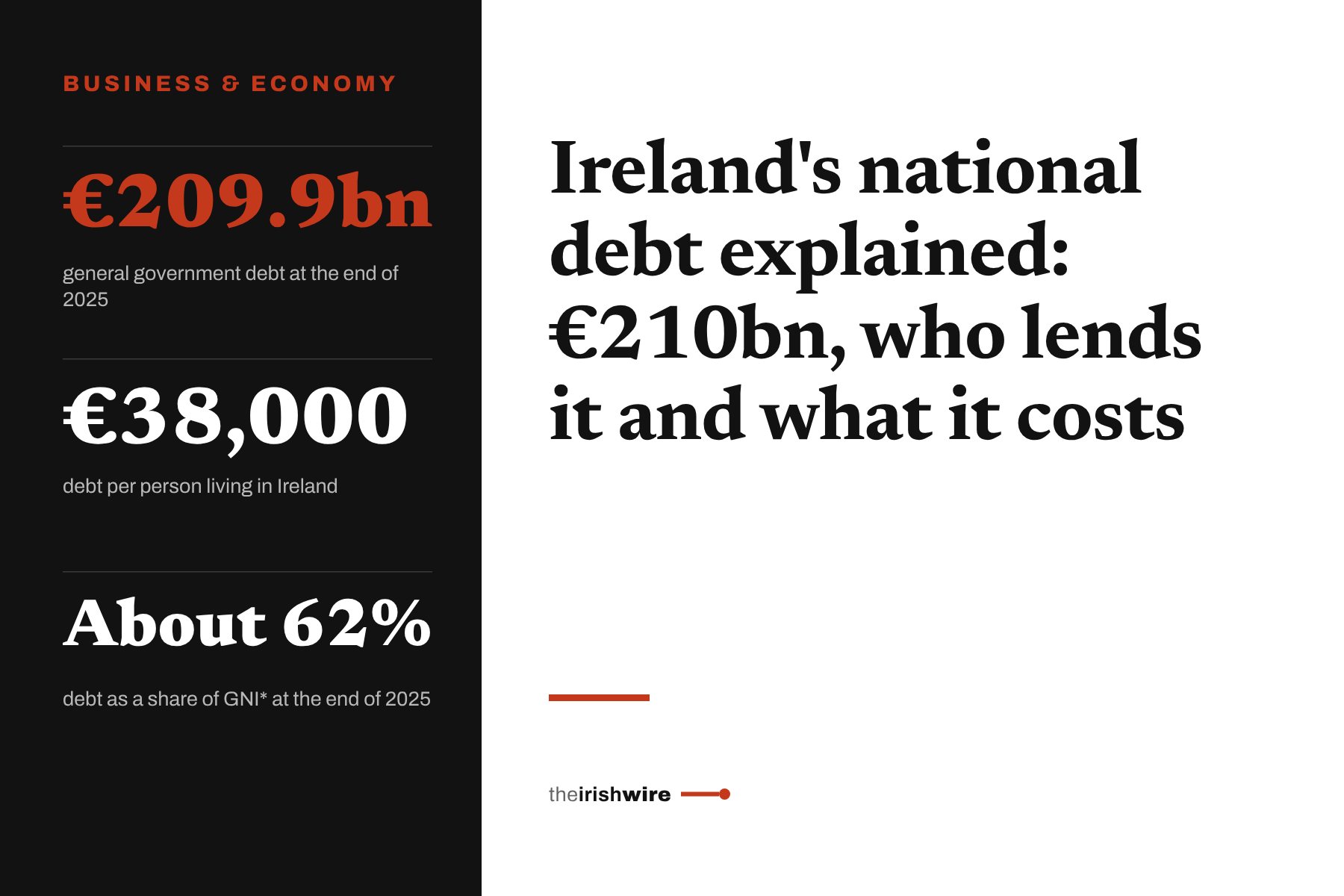
How much the State owes, what that means per person, who lends Ireland the money, what the interest bill is and why the debt is set to rise again even with budget surpluses.
The Irish State owes about €38,000 for every person living here. That is the total debt of €209.9 billion at the end of 2025, divided by the population. The debt has now fallen four years in a row, but official forecasts say it will rise again.
The debt is €209.9 billion
The main measure is general government debt. It covers money owed by central government, local councils and some other State bodies. The CSO, the Central Statistics Office, put it at €209.9 billion at the end of 2025.
That is €25 billion below the peak at the end of 2021. The figure comes from the NTMA, the National Treasury Management Agency, which borrows money for the State.
Comparing debt with the size of the economy is tricky in Ireland. Large multinationals inflate GDP, so the NTMA says it is not a good guide. It uses GNI* instead: modified gross national income, a CSO measure that strips out some of those effects.
On that basis, debt was about 62% of GNI* at the end of 2025, using the CSO's April 2026 estimates. Net debt, which subtracts the State's cash and other financial assets, was €138.4 billion.
Who lends Ireland the money
The NTMA also counts the gross national debt. It is measured on a different basis, so it does not match the figure above. At the end of 2025 it was €232.2 billion, and the table shows where the money came from.
| Type of borrowing | € billion | Share |
|---|---|---|
| Government bonds | 138.9 | 59.8% |
| EU loans | 38.2 | 16.4% |
| Short-term borrowing | 24.6 | 10.6% |
| State Savings | 19.4 | 8.4% |
| Borrowing from Ministerial Funds | 5.8 | 2.5% |
| Other medium and long-term debt | 5.3 | 2.3% |
| Total | 232.2 | 100% |
Most of the debt is government bonds. A bond is an IOU: investors lend the State money, get interest each year, and get their money back on a set date.
In 2025 the NTMA sold €8.5 billion of new bonds. On average they were lent for 18.7 years at a yield, or interest rate, of 3.08%. A €3 billion 30-year bond sold in January 2025 went 96% to investors outside Ireland.
The EU loans include €17.3 billion still owed to the European Financial Stabilisation Mechanism, an EU lending fund.
State Savings products, such as Prize Bonds, are a way for ordinary savers to lend to the State. The State Savings website says these savings are 100% protected by the Irish State.
The interest bill is about €530 a person
The State paid €2.9 billion in interest in 2025. That works out at about €530 for every person in the country. In 2013, after the financial crash, the bill was €7.8 billion.
The bill stayed low because almost all of Ireland's debt is at fixed rates. The average rate is about 1.5%, the NTMA says.
New borrowing costs more than that. As old, cheap debt is paid off and replaced, the bill will climb.
interest bill the Fiscal Advisory Council forecasts for 2030, more than double today
Source: fiscalcouncil.ieWhy the debt will rise again
The NTMA expects the debt to rise to "close to a quarter of a trillion euro". That is close to €250 billion.
This is happening while the budget is in surplus. In his Budget 2027 speech, Tánaiste and Minister for Finance Simon Harris forecast a surplus of €6.7 billion this year and €9.5 billion in 2027.
“Ireland's government debt is now set to rise by more than €35 billion by 2030.”— Irish Fiscal Advisory Council, Flash Release on Budget 2027, 6 October 2026
Part of the reason is that the State is saving and borrowing at the same time. It is putting large sums into two long-term funds.
Two State funds for the future
The Future Ireland Fund gets 0.8% of GDP each year from 2024 to 2035. It is meant to help pay for things like an ageing population from 2041 onwards. The Department of Finance says it could reach €100 billion by 2040.
The Infrastructure, Climate and Nature Fund gets €2 billion a year from 2024 to 2030. Up to 25% can be used in a downturn. From 2026, money can also go to climate and nature projects, up to €3.15 billion by 2030.
Budget 2027 adds an extra €1 billion to the Future Ireland Fund next year. That is on top of a planned transfer of around €4.8 billion.
What the Fiscal Council says
The Irish Fiscal Advisory Council is the State's independent budget watchdog. It published its first view of Budget 2027 on 6 October 2026. Its main points:
- Spending and tax changes rise by almost 9% in 2026 and at least 6% in 2027
- That is faster than the 5% a year it sees as sustainable
- The State spends about six of every seven euro of corporation tax
- Without excess corporation tax, deficits would reach €20 billion in a few years
- From next year, the State will in effect borrow to pay into its savings funds
Corporation tax comes from a small number of very large firms. We cover that in our piece on record corporation tax.
The Government's view, set out by Minister Harris on Budget day, is that the State needs to invest the rise in corporation tax "rather than rely upon them". He said surpluses will continue for the rest of the Government's term.
A budget surplus means the State is paying off its debt.
Not always. Debt fell four years in a row to €209.9 billion, but the Fiscal Council expects it to rise by more than €35 billion by 2030, even with surpluses forecast.
What this means for you
- Debt per person is a way to picture the size of the debt. It is not a bill anyone will receive.
- Money in State Savings, such as Prize Bonds, is 100% protected by the State.
- Every euro spent on interest is a euro not available for other spending, so a rising interest bill matters for future budgets.
- The Fiscal Council's full report on Budget 2027 is due in November 2026.
CSO publishes detailed 2025 government finance tables
Fiscal Advisory Council publishes its full Fiscal Assessment Report on Budget 2027
Future Ireland Fund and Infrastructure, Climate and Nature Fund expected to pass €23 billion combined
Last year of €2 billion payments into the Infrastructure, Climate and Nature Fund, after which they are reviewed
Future Ireland Fund can start supporting State spending
- CSO: Government Finance Statistics Annual, Provisional Estimates 2022 to 2025 (October 2026)
- CSO: Government Finance Statistics 2025 (April 2026), Revenue and Expenditure
- CSO: Population and Migration Estimates, April 2026
- NTMA: Funding and Debt Management statistics
- NTMA: 2026 mid-year business update, 8 July 2026
- NTMA Annual Report 2025: Funding and Debt Management
- NTMA: Investor Presentation, July 2026
- NTMA: Infrastructure, Climate and Nature Fund FAQs
- Department of Finance: Minister commences long-term funds, 1 August 2024
- Department of Finance: Statement by Tánaiste Simon Harris on Budget 2027
- Irish Fiscal Advisory Council: Flash Release, Budget 2027
- State Savings
