

The latest CSO figures show more people at work than ever, while the jobless rate has crept up over the past two years. Here is what the numbers say about young people, sectors and who is looking for work.
More people are working in Ireland than ever before: 2,839,300 in the three months to June 2026. Yet unemployment is also higher than two years ago. Both are true because the number of people in the workforce keeps growing.
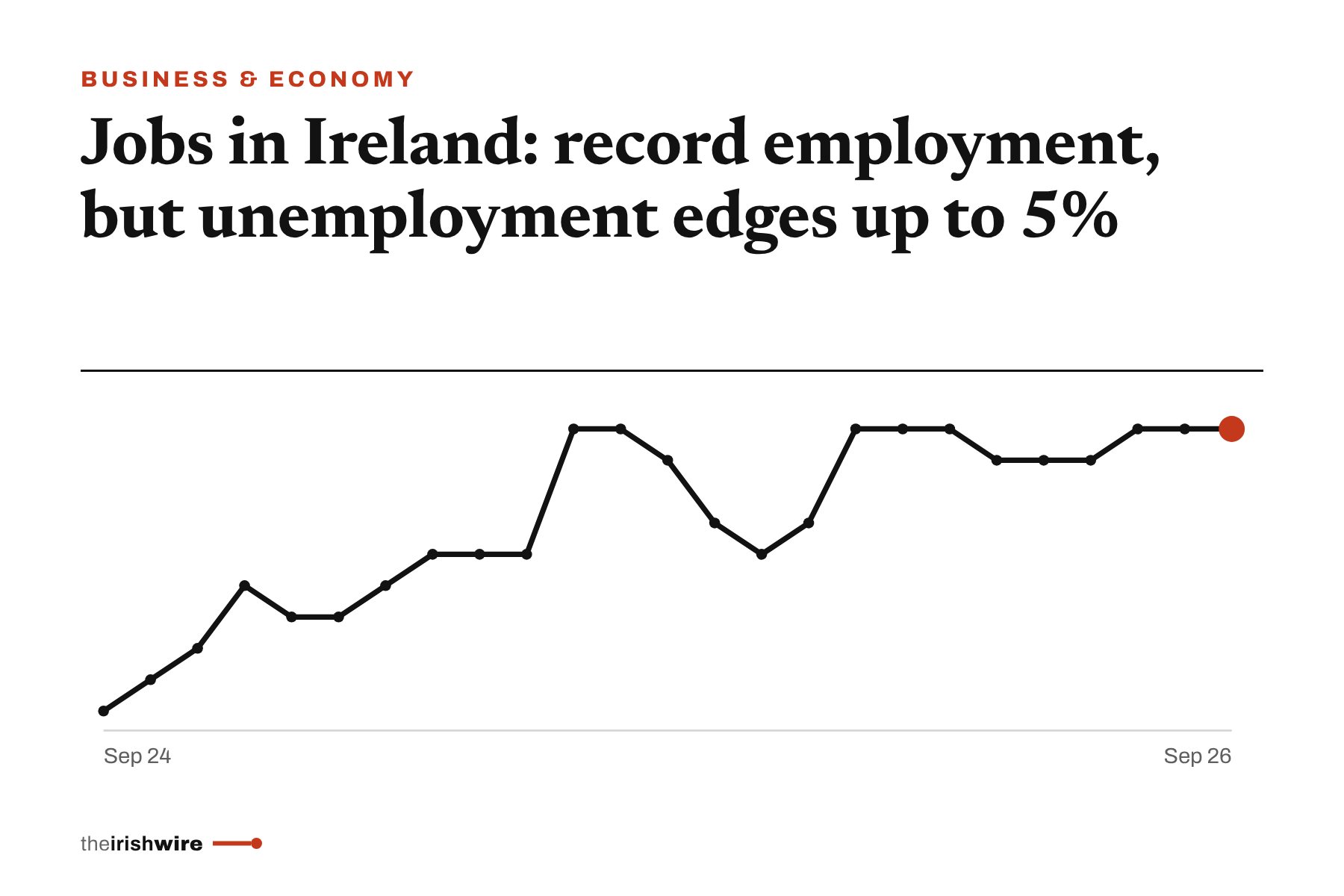
Unemployment has crept up to 5%
The Central Statistics Office (CSO) puts the unemployment rate at 5.0% in September 2026. That is the same as August, and up from 4.9% a year earlier. About 149,500 people were unemployed: 76,700 men and 72,800 women.
To count as unemployed, a person must be without work, available to start, and actively looking. The monthly rate is seasonally adjusted, which means regular yearly patterns are smoothed out.
Young people find it hardest
For people aged 15 to 24, unemployment was 12.5% in September 2026. That is about 45,500 young people. For people aged 25 to 74 the rate was 4.0%.
Many young people are in school or college and not looking for work, so they are not counted as unemployed. The quarterly survey, which is not seasonally adjusted, put youth unemployment at 13.2% in April to June.
Jobs keep growing, but more slowly
Employment rose by 21,200 in the year to the second quarter of 2026, or 0.8%. In the year before that, it grew three times as fast, by 63,900.
Since the same quarter in 2021, employment has grown by 457,100, or 19%. Women in work passed 1.3 million, at 1,335,600.
| Measure | 2025 | 2026 |
|---|---|---|
| People in work | 2,818,100 | 2,839,300 |
| People unemployed | 140,800 | 151,000 |
| Unemployment rate | 4.8% | 5.1% |
| Employment rate, ages 15 to 64 | 74.7% | 74.3% |
| Participation rate | 66.4% | 66.0% |
| Part-time workers | 582,000 | 589,600 |
| Long-term unemployed (1 year+) | 31,700 | 38,900 |
The quarterly survey rate (5.1%) differs a little from the monthly rate (5.0%). The quarterly figure is not seasonally adjusted, and it covers April to June.
Over five years the rate is still lower. In April to June 2021 it was 7.3%. The employment rate for people aged 15 to 64 peaked at 75.3% in July to September 2024, the highest since 1998.
Who is working or looking for work
The participation rate is the share of people aged 15 and over who either have a job or are looking for one. It was 66.0%, down from 66.4%. For men it was 70.8%, and for women 61.3%.
people in the labour force, meaning in work or looking for work, up 31,300 in a year
Source: cso.ieThe CSO says the growing population added 37,000 to the labour force. Lower participation took away 5,700.
Gains in education and transport, losses in professional services
Education added 14,200 workers in a year, up 5.9%. Transport and storage added 9,800, including 6,900 in air transport.
Professional, scientific and technical work lost 17,100 jobs, down 8.2%. Most of that fall, 11,800, was in architecture, engineering and technical testing.
In all, people worked 89.0 million hours a week, the same as a year earlier. Education gained the most, 600,000 hours a week. Professional, scientific and technical work lost the most, 800,000 hours.
Public and private sector jobs
Most employees work in the private sector: 1,846,100 in early 2026. The public sector, including semi-state bodies, employed 462,100.
Health is the biggest part of the public sector, with 169,900 employees. Education has 109,800 and the civil service 54,300.
How Ireland compares with the EU
In January to March 2026, Ireland's unemployment rate was 4.9% on the EU statistics office (Eurostat) measure. The EU average was 6.2%. Ireland's employment rate was 73.3%, above the EU's 70.8%.
Working patterns have also changed. Close to 1 million people now work from home at least some of the time.
Part-time work and people wanting more hours
About 589,600 people work part-time, one in five of all workers. Of these, 153,800 are underemployed. That means they work part-time but want more hours and could take them.
For take-home pay at different salaries, see our salary after tax guide.
What the monthly figure can and cannot tell you
- The official measure of unemployment is the quarterly Labour Force Survey, not the monthly estimate.
- The monthly figure projects recent months using the trend in the Live Register, which is based on Department of Social Protection records.
- So the latest months are forecasts, and larger revisions can follow when new survey data arrive.
- Being on the Live Register is not the same as being unemployed. Unemployed means actively looking for work.
In short, use the monthly figure for the direction of travel and the quarterly survey for the settled picture.
What this means for you
- Jobs are still growing, but unemployment has drifted up from about 4% to 5% since late 2024.
- If you are 15 to 24 and looking for work, the odds are tougher: about one in eight young people in the labour force is unemployed.
- If you lose your job, apply for a Jobseeker's payment quickly. See our how-to guide on Jobseeker's Benefit and Allowance.
- Part-time and want more hours? You are one of 153,800 people in the same position.
- The latest monthly figures are early estimates and may be revised.
Rising unemployment means fewer people have jobs.
Both went up together. Employment rose by 21,200 in the year to mid-2026, while unemployment rose by about 10,000, because more people joined the workforce.
CSO Monthly Unemployment for October 2026
CSO Labour Force Survey for July to September 2026
Revisions to the July to September monthly rates once the quarterly survey is in
- CSO: Monthly Unemployment September 2026
- CSO: Labour Force Survey Quarter 2 2026, Key Findings
- CSO: Labour Force Survey Quarter 2 2026, Employment
- CSO: Labour Force Survey Quarter 2 2026, Labour Force
- CSO: Employment Trends in Ireland, what CSO data tells us, 31 August 2026
- CSO PxStat: QLF57 Persons in employment by broad NACE Rev 2.1 sector
- CSO PxStat: QLF02 ILO participation and unemployment rates
