

Help to Buy has risen to €35,000. Here is what each State scheme pays, who qualifies, and how they add up on a €400,000 new home.
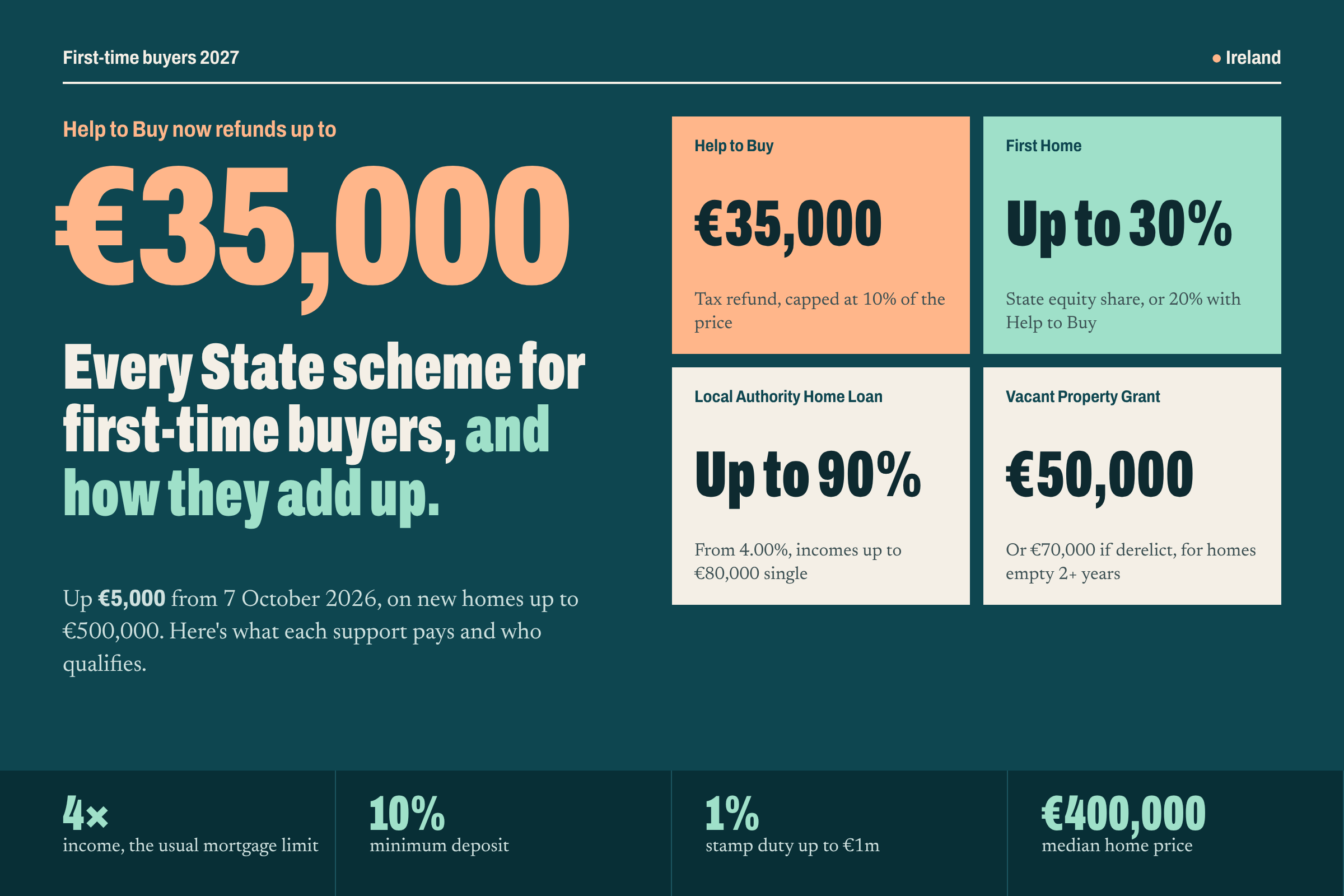
Since 7 October 2026, Help to Buy can give a first-time buyer back up to €35,000 of the income tax they paid. That is €5,000 more than before, and it runs to 31 December 2029. It is one of five State schemes for first homes.
Five schemes, five different kinds of help
Some give you money back, some take a share of your home, and one lends you the mortgage. You can combine some, but not all.
| Scheme | What you get | Who qualifies |
|---|---|---|
| Help to Buy | Up to €35,000 of tax back, capped at 10% of the price | Buyers of a new home or self-build worth €500,000 or less |
| First Home | Up to 30% of the price (20% with Help to Buy) in return for a share of the home | First-time or fresh start buyers of a new home under the local price ceiling |
| Local Authority Home Loan | Mortgage of up to 90% of the value, fixed at 4.00% or 4.05% | Single income up to €80,000, joint up to €85,000 |
| Starter Home Purchase | A new home below market price; the council keeps a 5% to 40% share | Moderate incomes; homes are advertised by councils |
| Vacant Property Refurbishment Grant | Up to €50,000, or €70,000 if derelict | Owners of homes built before 2008 and empty for two years or more |
Help to Buy now pays up to €35,000
Help to Buy refunds income tax and DIRT you paid in the four tax years before you apply. DIRT is the tax taken from the interest on your savings. You get the lowest of three amounts: €35,000, 10% of the price, or the tax you actually paid.
The home must be newly built, or a self-build, and cost €500,000 or less. Your mortgage must be at least 70% of the price. This is the loan-to-value rule: the size of your loan compared with the value of the home.
“increase the maximum refund a first-time buyer can claim by €5,000, to €35,000, with immediate effect.”— Tánaiste and Minister for Finance Simon Harris, Budget 2027 statement, 6 October 2026
In 2025, Revenue approved 9,575 claims worth about €252.9 million. The average home in those claims was valued at €418,500.
Help to Buy can be used on any first home.
It only covers new builds and self-builds worth €500,000 or less, with a mortgage of at least 70% of the price. A second-hand home does not qualify.
First Home buys a slice of your home
The First Home Scheme fills the gap between your deposit plus mortgage and the price of a new home. In return it takes an equity share: it owns a percentage of your home until you buy it back.
It can fund up to 30% of the price, or 20% if you also use Help to Buy. The minimum is 2.5% or €10,000, whichever is higher. You need a 10% deposit, and you must borrow the most a participating lender will give you.
A yearly service charge of 1.75% starts in year six if you still owe the share. To buy it back, you pay the same percentage of the home's value at that time.
| Local authority area | House ceiling | Apartment ceiling |
|---|---|---|
| Dublin (all four councils), Cork City, Wicklow | €500,000 | €500,000 |
| Kildare, Meath, Galway City | €475,000 | €475,000 |
| Cork County, Galway County, Limerick | €450,000 | €450,000 |
| Kerry, Louth, Mayo | €425,000 | €425,000 |
| Waterford | €400,000 | €450,000 |
| Clare, Donegal, Kilkenny, Wexford, Westmeath | €400,000 | €400,000 |
| Carlow, Cavan, Offaly, Tipperary | €375,000 | €375,000 |
Your council can lend you the mortgage
The Local Authority Home Loan is a State-backed mortgage from your council. It lends up to 90% of the value of the home. The rate is fixed: 4.00% (APR 4.07%) up to 25 years, or 4.05% (APR 4.13%) up to 30 years.
Since 1 April 2026, the income limit is €80,000 for a single person and €85,000 for a couple. You cannot use it with First Home. The home's price must be under the cap for your area:
- €415,000: Dublin, Kildare, Wicklow
- €375,000: Cork, Galway City, Meath
- €345,000: Galway County, Louth, Clare, Kilkenny, Limerick, Waterford, Westmeath, Wexford
- €310,000: Carlow, Cavan, Donegal, Kerry, Laois, Leitrim, Longford, Mayo, Monaghan, Offaly, Roscommon, Sligo, Tipperary
Cheaper new homes and grants for empty ones
Under the Starter Home Purchase Scheme (until 2026 the Affordable Purchase Scheme), councils and the Land Development Agency sell some new homes below market value. The council keeps a share equal to the discount.
To qualify, four times your gross income must come to less than 85.5% of the home's market value. Homes are advertised one at a time on council websites and NewStarterHomes.ie.
If you buy an older empty home, the Vacant Property Refurbishment Grant pays up to €50,000 towards the work. A derelict home can get up to €70,000. It must have been built before 2008 and be empty for at least two years.
the most the Vacant Property Refurbishment Grant pays for a derelict home
Source: gov.ieThe limits every bank works within
The Central Bank sets limits on mortgage lending. A first-time buyer can usually borrow up to four times their gross income. You need a deposit of at least 10%, so the loan can be no more than 90% of the price.
Banks may go above these limits for up to 15% of first-time buyer loans, but that is their choice.
The median is the middle price. In Kildare it was €450,000. There were 1,811 first-time buyer purchases in August 2026, up from 1,617 a year earlier.
Stamp duty is 1% on homes up to €1 million. On a new home you pay it on the price without VAT, so Revenue's €400,000 example comes to about €3,524.
Worked example: a €400,000 new home in Kildare
This is an illustration only. A couple earn €80,000 a year between them and paid over €35,000 in income tax in four years. Their new €400,000 home is under the Kildare First Home ceiling of €475,000.
- Deposit needed (10%): €40,000
- Help to Buy: €35,000, so they save €5,000 themselves
- Mortgage at four times income: €320,000, or 80% of the price
- Gap left: €400,000 minus €40,000 minus €320,000 = €40,000
- First Home share: €40,000, which is 10% of the home
- Stamp duty on top: about €3,524, plus legal fees
The mortgage is 80% of the price, so it passes the Help to Buy 70% rule. Buying back the 10% share when the home is worth €450,000 would cost €45,000.
The order to apply in
- Check the income tax and DIRT you paid over the last four years in Revenue myAccount.
- Save a deposit of at least 10% of the price you expect to pay.
- Get mortgage approval in principle from a lender, or apply to your council for a Local Authority Home Loan.
- Apply for Help to Buy in myAccount, or ROS if you are self-employed.
- If you need First Home, apply online with your approval in principle and check your area's price ceiling.
- Sign the contract, then make your Help to Buy claim; your builder or solicitor verifies it.
Tips before you start
- Check your own Help to Buy figure first: it is capped by the tax you paid.
- A very large deposit can push your mortgage under 70% of the price and rule you out of Help to Buy.
- First Home and the Local Authority Home Loan cannot be combined, so compare both.
- A First Home share rises and falls with your home's value.
- Budget for stamp duty and legal fees.
First Home price ceilings are reviewed twice a year; in 2025 changes came in January and July
First Home is funded to June 2027 under its last announced extension; watch for news on what follows
The €35,000 Help to Buy limit applies to applications up to this date
- Revenue: Help to Buy, how much can you claim
- Revenue: Help to Buy, what type of property qualifies
- Citizens Information: Help to Buy Scheme
- Department of Finance: Statement by Minister Harris on Budget 2027
- Department of Finance: Budget 2027 Tax Policy Changes summary
- Revenue: Help to Buy annual statistics reports 2021 to 2025
- First Home Scheme: About the scheme
- First Home Scheme: Property price ceilings
- First Home Scheme: Annual Report and Financial Statements 2025
- Citizens Information: First Home Scheme
- Department of Housing: First Home Scheme extended to 2027 (13 May 2025)
- Local Authority Home Loan: Eligibility
- Local Authority Home Loan: Interest rates
- Citizens Information: Local Authority Home Loan
- Housing Agency: Starter Home Purchase Scheme
- Citizens Information: Starter Home Purchase Scheme
- Department of Housing: Q1 2026 affordable housing delivery
- Department of Housing: Vacant Property Refurbishment Grant
- Central Bank of Ireland: What are the mortgage measures
- Revenue: Stamp Duty rates on property
- Revenue: VAT-exclusive consideration
- CSO: Residential Property Price Index August 2026
- CSO: Residential Property Price Index December 2025, key findings
