
The Irish language occupies a position in national life that is simultaneously central and marginal, officially celebrated and practically sidelined, the subject of enormous policy attention and a source of genuine ambivalence in the population whose ancestors spoke it. It is the first official language of the State; it is compulsory in schools for thirteen years; it is present on every road sign, government document and Oireachtas debate; and it is spoken as a daily language by a small and geographically concentrated minority of Irish people.
Whether the language is in revival or retreat whether the policy attention and public investment of the past several decades is producing measurable improvement or merely sustaining a dignified decline is a question that generates significant heat and rather less light in Irish public debate. This article examines what the evidence actually shows: the census data on Irish speakers, the Gaeltacht population trends, the education system’s effects, and the initiatives that have produced genuine community-level results.
What the Census Data Shows
The Census 2022 data on the Irish language shows that approximately 1.87 million people about 40% of the population reported being able to speak Irish. Of these, approximately 73,000 reported speaking Irish daily outside the education system, the figure most commonly cited as reflecting genuine active use. This represents a small increase on 2016, continuing a gradual upward trend that has been visible in the data since the 2011 census.
However, the 73,000 figure requires careful interpretation. It includes people in the Gaeltacht where Irish is a community language, people who use Irish daily in Irish-medium education settings people working in Irish-language media and public institutions and people who speak Irish regularly with family or friends outside those institutional contexts. The number of people for whom Irish is genuinely the dominant or preferred language of daily life rather than one they use regularly alongside English is smaller than 73,000.
The Gaeltacht population, as measured by the proportion of residents using Irish as their daily language, has continued to decline in some of its traditional core areas. The language planning process established under the Gaeltacht Act 2012, which requires each Gaeltacht language planning area to develop a 20-year language plan with specific targets, has produced plans of varying quality and ambition, with mixed implementation.
The Education System: What Works and What Does Not
Irish is a compulsory subject in primary and secondary schools for all students except those from non-English-speaking backgrounds (who have an exemption mechanism) and students with certain learning disabilities (who may apply for an exemption). The compulsory Irish requirement has been the subject of periodic political debate, with Fine Gael in particular having historically advocated for making Irish optional at Leaving Certificate level. That debate has not produced policy change, partly because of determined opposition from Irish language organisations, the Gaeltacht community and cultural organisations including Conradh na Gaeilge.
The effectiveness of compulsory Irish in producing active speakers is, by most measures, limited. Students who complete thirteen years of Irish-language education typically emerge with a passive competence they can understand more than they can produce and production under pressure (conversation) is far weaker than recognition. The teaching methodology in many schools has historically emphasised grammar and translation over oral communication, producing the characteristic Irish experience of studying Irish for years and still being unable to hold a conversation.
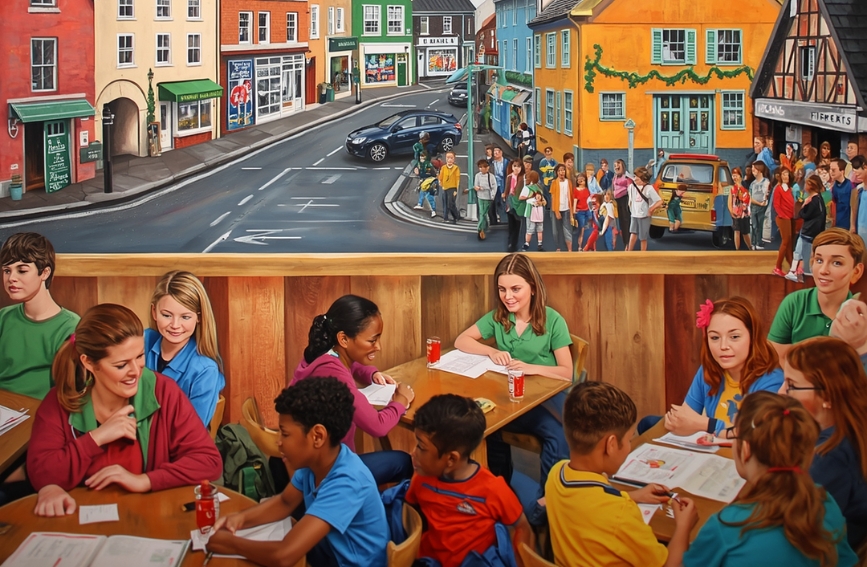
Irish-medium education the Gaelscoileanna and Gaelcholáistí, where all subjects are taught through Irish, produces significantly stronger outcomes. Students who complete primary and secondary education through the medium of Irish emerge as confident, fluent speakers. The Gaelscoil network has expanded significantly in recent decades, with schools now in most urban areas of Ireland. Demand for Gaelscoileanna consistently exceeds places in most major cities, which is both a measure of parental interest in Irish-medium education and a challenge for the Department of Education in meeting that demand.
TG4 and Irish Language Media
The establishment of Teilifís na Gaeilge (now TG4) in 1996 was the most significant investment in Irish language culture of the modern period. The channel, funded by the State and generating additional income through the independent production commissioning process, broadcasts primarily in Irish with some English-language content and subtitling. It has produced original Irish-language drama, documentary, sport and arts programming to a standard that is genuinely competitive with English-language broadcasting.
TG4’s audience is not limited to Irish speakers. Research consistently shows that a significant proportion of TG4’s audience is people who do not speak Irish fluently but watch the channel for its programming — particularly GAA coverage, nature documentaries, and drama — with subtitles. This means the channel functions both as a service for Irish speakers and as a portal through which the wider population encounters Irish-language culture.
The Urban Irish-Speaking Community
One of the more interesting developments in Irish language culture over the past two decades is the growth of an urban Irish-speaking community that is not rooted in the Gaeltacht tradition. Young people in Dublin, Cork and Galway who attended Gaelscoileanna or developed strong Irish through secondary school have, in some cases, formed social networks, arts scenes, and community organisations in which Irish is the language of choice. This urban Irish-speaking community is small, a few thousand people in Dublin but it is voluntary, dynamic, and qualitatively different from the institutional Irish of government and schools.
Organisations like Gaelphobal and events like Seachtain na Gaeilge (Irish Language Week) provide focal points for this community. The club culture of Gaelic games, where Irish is used in team environments and on the field of play also sustains social use of the language in communities where it is not the domestic language. Whether this urban voluntary usage can grow sufficiently to shift the overall trajectory of the language from slow decline to genuine stabilisation is the central question for Irish language policy over the next generation.
